26 Aug 2026
Regulatory Nuances Shaping Match Offer Distribution in Swiss Progressive Prize Pools

Swiss gaming authorities maintain strict oversight over progressive prize pools, and match offer distribution falls under layered compliance requirements that operators must navigate with precision. The Federal Act on Games of Chance and Casinos sets baseline standards while cantonal rules add further conditions on how contributions accumulate and how matching allocations reach players. Data from the Federal Gaming Board shows progressive systems must separate player-funded portions from any operator-matched amounts to preserve transparency in payout calculations.
Core Framework Under Federal Oversight
Operators licensed through the Federal Gaming Board must document every match offer component before it enters a progressive pool, and this documentation includes timestamped ledgers that track contributions across multiple game sessions. Those who study Swiss gaming compliance note that match offers cannot blend with house-edge reserves, which forces separate accounting streams. Research indicates these separations reduce disputes during jackpot verification processes and align with anti-money laundering protocols updated in recent years.
Progressive prize pools in Switzerland operate under contribution caps that limit how much any single match offer can add per round, and these caps adjust based on average stake levels reported quarterly. And regulators require independent audits to confirm that match distributions scale proportionally with player participation rather than fixed operator commitments. Figures from licensed platforms reveal that pools reaching certain thresholds trigger mandatory reviews before further matches can be added.
Cantonal Variations in Allocation Rules
Each canton applies its own interpretation when match offers feed into progressive systems, and some require additional player registration steps before eligibility activates. Zurich and Geneva, for instance, enforce distinct verification timelines that affect how quickly matched amounts integrate into live pools. Observers note these differences create operational challenges for platforms serving multiple regions, since uniform software must accommodate varying approval sequences.
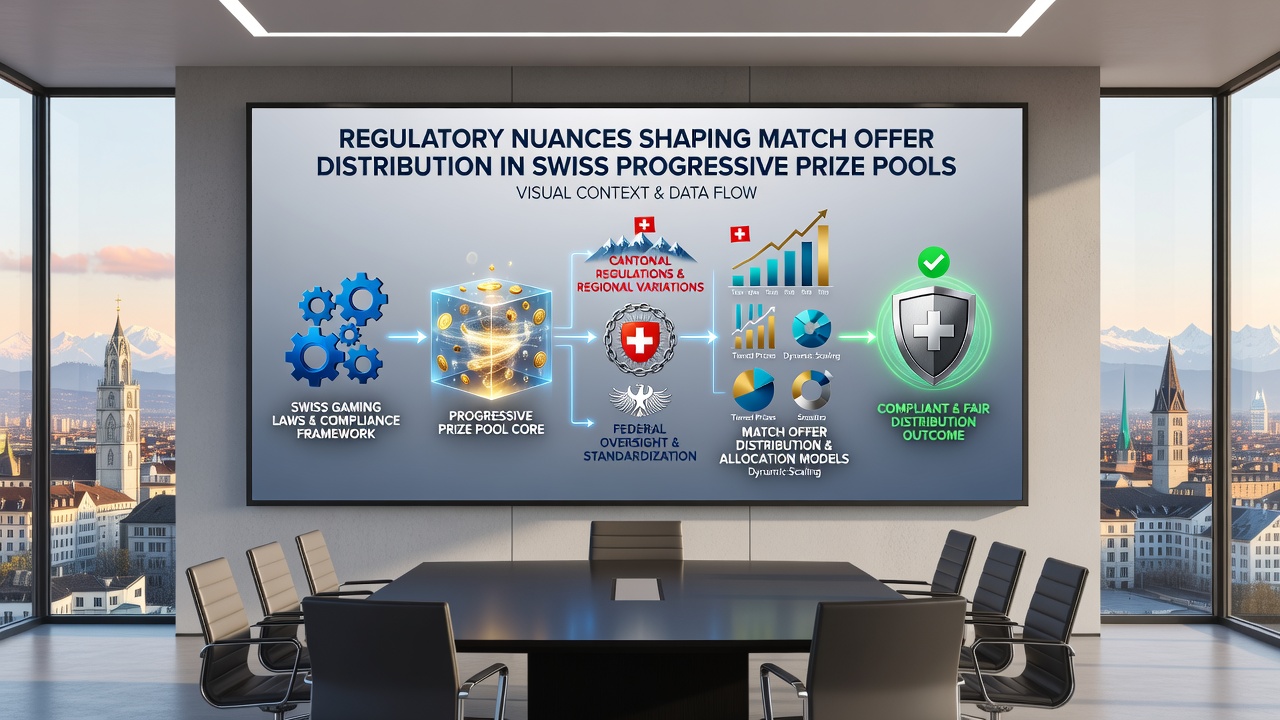
August 2026 brings scheduled alignment meetings between federal and cantonal bodies to standardize certain match offer reporting formats, and early guidance suggests simplified templates will replace current fragmented submissions. Those preparing for the change point out that consistent data fields should streamline audits without altering underlying contribution formulas. Swiss authorities have published preliminary checklists that operators can reference during system updates ahead of the deadline.
Technical Compliance and Reporting Mechanisms
Match offer distribution requires real-time logging that feeds into centralized monitoring portals maintained by the Federal Gaming Board, and any deviation above predefined variance thresholds generates automatic alerts. Studies on Swiss progressive systems highlight that these alerts often precede full reviews when match percentages fluctuate beyond historical norms. Operators therefore invest in automated reconciliation tools that cross-check pool totals against individual match records on a daily basis.
External testing laboratories must certify that progressive algorithms correctly apportion matched amounts according to regulatory formulas, and certification renewals occur at intervals defined by the licensing authority. Data shows certified systems experience fewer payout delays when jackpots trigger, because pre-approved logic already accounts for match offer layers. Platforms that fail initial certification face extended review periods before they can resume progressive game offerings.
Cross-Border Considerations and Industry Standards
Swiss rules intersect with broader European data protection standards when match offer records contain player identifiers, and operators must segregate these records from general marketing databases. Federal Gaming Board guidelines emphasize encryption requirements that apply specifically to progressive pool data flows. Meanwhile, comparisons with systems in other jurisdictions, such as those documented by the Australian Gambling Research Centre, illustrate how Swiss contribution caps differ from percentage-based models used elsewhere.
Industry associations have compiled case summaries where match offer misalignments led to temporary pool freezes, and these examples underscore the value of pre-launch simulations. Regulators encourage operators to run scenario tests that replicate peak activity periods to verify distribution accuracy under stress conditions.
Conclusion
Regulatory nuances in Swiss progressive prize pools continue to evolve through coordinated federal and cantonal efforts, with match offer distribution remaining a focal point for compliance teams. August 2026 alignment initiatives may reduce some procedural friction while preserving core safeguards around transparency and player protection. Operators who maintain rigorous documentation and audit trails position themselves to adapt smoothly as standards develop further.